

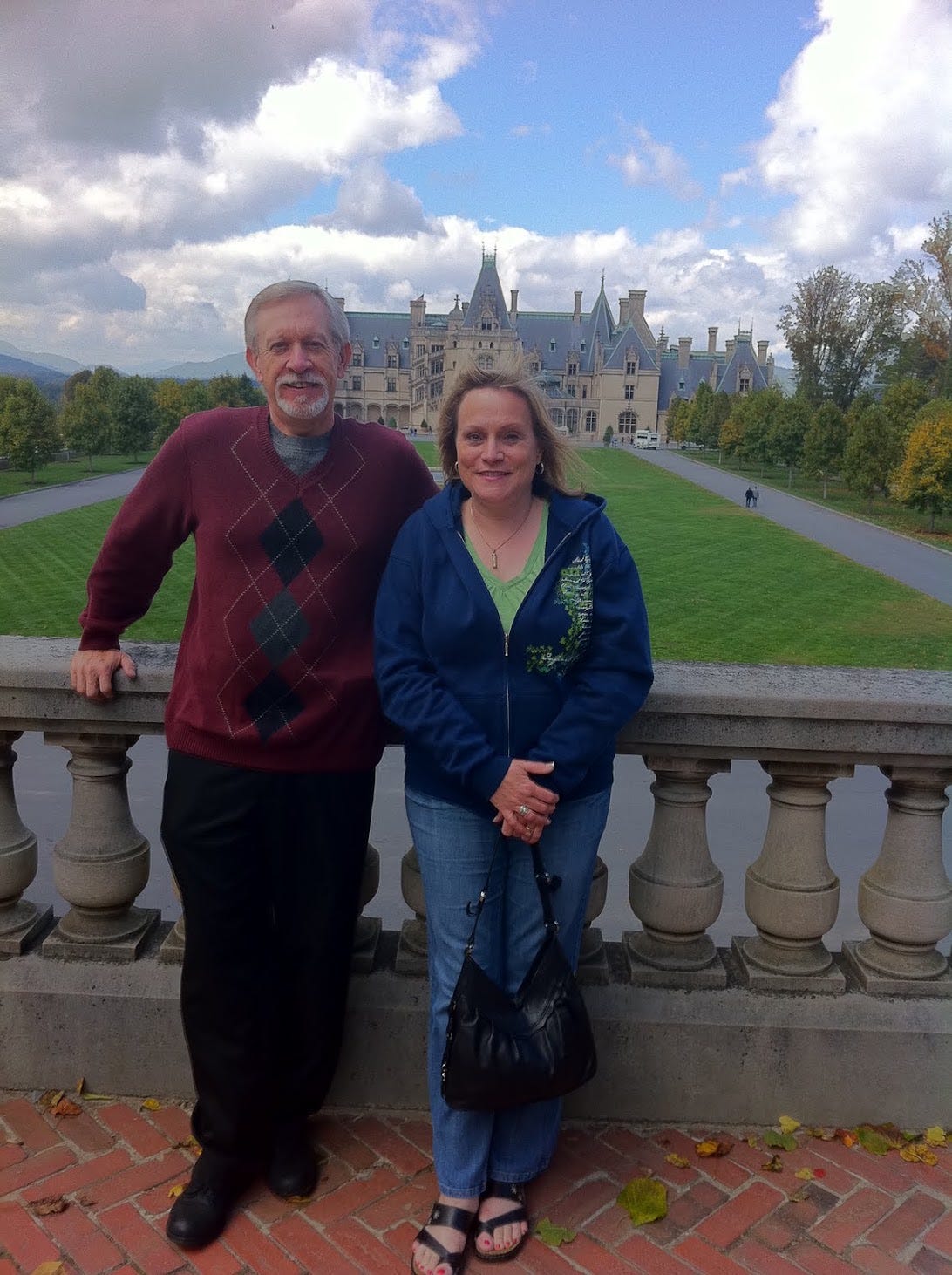
A dear brother-in-Christ faithfully pastored his Baptist church in North Carolina for 25 years before retiring at the end of December 2020, and now works for a Baptist association. We have been friends since we connected on Facebook and then met in person when Nick and I visited North Carolina in October 2010 and even toured Biltmore with him. At that time, Nick and I were faithful evangelicals who shared much about our love for Christ with him and his wife.
I believe the Christian love we share is real. However, we have had a number of conversations about Nick and my move to Orthodoxy since we were received (or came back, in Nick’s case) in January 2023. The most recent discussion was via chat, when I sent this brother a link to one of the more recent Ancient Faith Today Live episodes, in which Fr. Thomas Soroka discussed “Beyond Imputation: Justification in Orthodoxy.” You can see the video recording here:
My dear friend sent me back a long message, responding to Fr. Tom’s video. Here are a few excerpts. I will try to answer them as best as I can. Again, these are excerpts. Also, I have italicized his response and adjusted a couple of items for readability.
“He is either ignorant or intentionally deceptive. He sets up straw man after straw man based on snippets of sermons/teaching. What he says evangelicals believe, “Protestants” as he sneers in branding them (I prefer Biblicist myself) is nothing I have heard from R.C. Sproul, John Piper, etc.”
I'll have to disagree with my friend here. While, yes, these are just short snippets that are featured, I listened to these men (R.C. Sproul, John Piper, John MacArthur, Paul Washer) for many years when I was an evangelical, and these snippets do represent their teaching. They were (some have left us), and are, all Reformed in their approach to the Bible, and this teaching clearly reflects these leanings. My friend is a Baptist and has been all his life, so naturally, he will interpret biblical passages in a more Baptist light. I have spent time (briefly) in an Assemblies of God church, non-denominational (and rather baptistic in nature) churches, an Evangelical Presbyterian Church. (EPC) church, and a Lutheran church affiliated with both the North American Lutheran Church (NALC) and Lutheran Congregations in Mission for Christ (LCMC). During these times, my preferences in listening to certain preachers changed, of course, but the snippets that Fr. Tom chose are not untrue or uncharacteristic.
“He makes the doctrine of justification a caricature. The way he describes it denies the richness—the depth and breadth of salvation. Justification is but one dimension of salvation. It deals with the penalty of sin—a past accomplished event that puts us in right standing with God.”
My dear friend feels that Fr. Tom is making fun of Protestants. I am not sure I can agree. He is simply explaining to Orthodox what Protestant beliefs are and highlighting that Orthodox have a very different understanding. In the Orthodox view, the term "justification" is not used. What my friend explains is the juridical understanding of Protestant theology, in which salvation is a point in time, i.e., when a person prays to ask Christ for forgiveness and to receive Him as Lord. My friend’s statement also highlights the further disconnect between Protestantism and Orthodoxy as to the work of Christ. To an Orthodox Christian, Christ conquered death by His own voluntary death, conquered sin, the devil, and Hades, all to restore mankind to communion with God. So if anything, this offers humanity a new beginning, not a past event.
“But, I also preach sanctification—that is a present work of Christ. It deals with the power of sin, that is both a present act and progressive action.”
Likewise, “sanctification" is not a concept that Orthodoxy speaks about. In the Orthodox understanding, we speak of kenosis, Christ’s self-emptying in His incarnation, without ever giving up His divinity. This He did in self-giving love and perfect obedience. To the Orthodox faithful, theosis is the life-long process, in which we, through God’s grace and participation in the life of Christ by the Holy Spirit, are more and more united with God and transformed into His likeness. We never become divine ourselves in this process. The goal is to be united wholly to God.
“Salvation also has a promised dimension—a future assurance of glorification—saved to sin no more. This is not even getting to the doctrine of regeneration and adoption.”
As a former evangelical, I can assuredly say that I never felt I was “saved to sin no more.” Sin abounded in all reality. As an Orthodox Christian, I have no assurance of salvation, but at the same time, I never feel fearful of meeting the God who loves me so much. It is because of the journey of theosis that I am on daily (and again, very different from my Protestant days), that I encounter my own repugnant sin in my life, can humble myself again and again, and offer it to God to forgive and heal me. Every day in the Orthodox morning prayers, Psalm 51 (50 in the Septuagint) is included. Every morning, I ask God again and again to forgive my sin, to wash me clean, to heal me, and to restore to me the joy of my salvation. Here is a great read on why Orthodox don’t discuss the question “Are you saved?"

“He mocks those who offer a get out of hell free card.” I have been scorning that for years! That is not the Gospel I preach. I preach the whole counsel of God—including the Gospels, Ephesians, and not just Romans and Galatians. There is not contradiction in any of it, by the way—rather a glorious harmony.”
My dear Friend, I simply can no longer follow you on this journey of thought. How can I have had this juridical moment in time where I have been forgiven my sin past, present, and future (my “salvation”), and yet you seem to indicate that wasn’t enough? Are we not back to telling men and women they need to follow God’s commandments, as given in the pages of the New Testament through the Gospels and the other New Testament books? I must believe you mean that you teach that
saving faith produces obedience (James 2:14–26),
believers are called to pursue holiness (Hebrews 12:14),
sanctification is the expected evidence of regeneration, and
the moral law reflects God’s character, even though Christians are no longer under the Mosaic covenant as a means of justification.
If that is what you mean, we Orthodox actually agree on several points. The first two for sure. The third one would not be described with this term of “sanctification,” or as evidence of regeneration; rather, the new life in Christ begins for an Orthodox believer in baptism and continues throughout life as an ongoing transformation. On the final point, we would largely agree, but nuance it a bit. Rather than viewing external rule-keeping, Orthodoxy will point to inward transformation.
“He promotes the false teaching of baptismal regeneration—that a dunk in water will wash your sins away and you get a white robe—and booyah—you’re saved! Yet, our righteousness is as filthy rags!”
Orthodoxy baptizes infants because baptism is understood primarily as God’s gift, not a reward for an individual’s profession of faith. It is understood that baptism is not an isolated event that guarantees salvation. Rather, it marks the beginning of the Christian life. St. Paul wrote in Galatians 3:27, “As many of you as were baptized into Christ have put on Christ.” This verse is central to an Orthodox understanding of baptism. We are given a new birth, in which we are united to Christ, forgiven of our sins, received into the Church, and can now start the lifelong journey of theosis. In the Orthodox view, we inherit Adam’s mortality, corruption, and a propensity to sin, but not his personal guilt. Baptism heals this fallen condition and unites us to Christ by imparting new life. When you hear Orthodox faithful pray “Moryo ethraḥam ’alayn” or “Kyrie eleison” (“Lord, have mercy”) again and again, it is not because they are asking God to stop being angry, but to heal them through His loving and life-bringing presence.
My friend concluded, “I do not understand the appeal except for those always looking for some new shiny thing (new to you, though it is false teaching that has been around for millennia).” I am so happy that the truly life-giving Orthodox faith is anything but a false teaching.
I know that part of the conversation always goes to “the teaching was corrupted in the early centuries of Christianity.” Why yes, it was! That is why councils were called to root those out, and why we all agreed to the words of the Nicene-Constantinopolitan Creed!
I find, rather, that my Protestant friends often don’t realize how far outside of the faith they wander when they, e.g., state that the Virgin Mary is the Mother of Christ, rather than the Mother of God. That is one wrong teaching by Nestorius that was addressed as early as the Council of Ephesus in AD 431.
I am also grateful, time and again, to have these discussions because they remind me how important it is to clarify to each other what we mean with our terms. Love you, my dear Friend in North Carolina, and may the Lord make our paths cross again in real life very soon. I invite you to participate in consultations for the Lausanne-Orthodox Initiative: https://www.loimission.net. In the meantime, I am grateful to Fr. Thomas Soroka, who sparked this discussion between my friend and me.